The dive site will be chosen according to sea conditions and the characteristics of the group.

The Pikatxilla is one of the star dives in the Bay of Biscay. It is a huge shoal located at the tip of Mompas, near the Zurriola beach, about 10 minutes away from the embarkation point. This shallows has historically been a black spot for any ship, since the top is very close to the surface. This has meant that there have been many accidents involving ships sailing in the area. The last one, the “Berriz Patxiku”, a fishing boat that hit the shallows in September 2017. Not in vain the name of Pikatxilla would translate as “keel cutter”. Because of them, we can find remains of different wrecks scattered around the area.
The bajo is a huge wall with an east-west orientation. The ridge is about 3-5 m. deep and drops to 30-32m. on the north side, and a little less on the south, to 25-26m. This bajo has an impressive concentration of life for being located in an area where the whole environment is sandy.
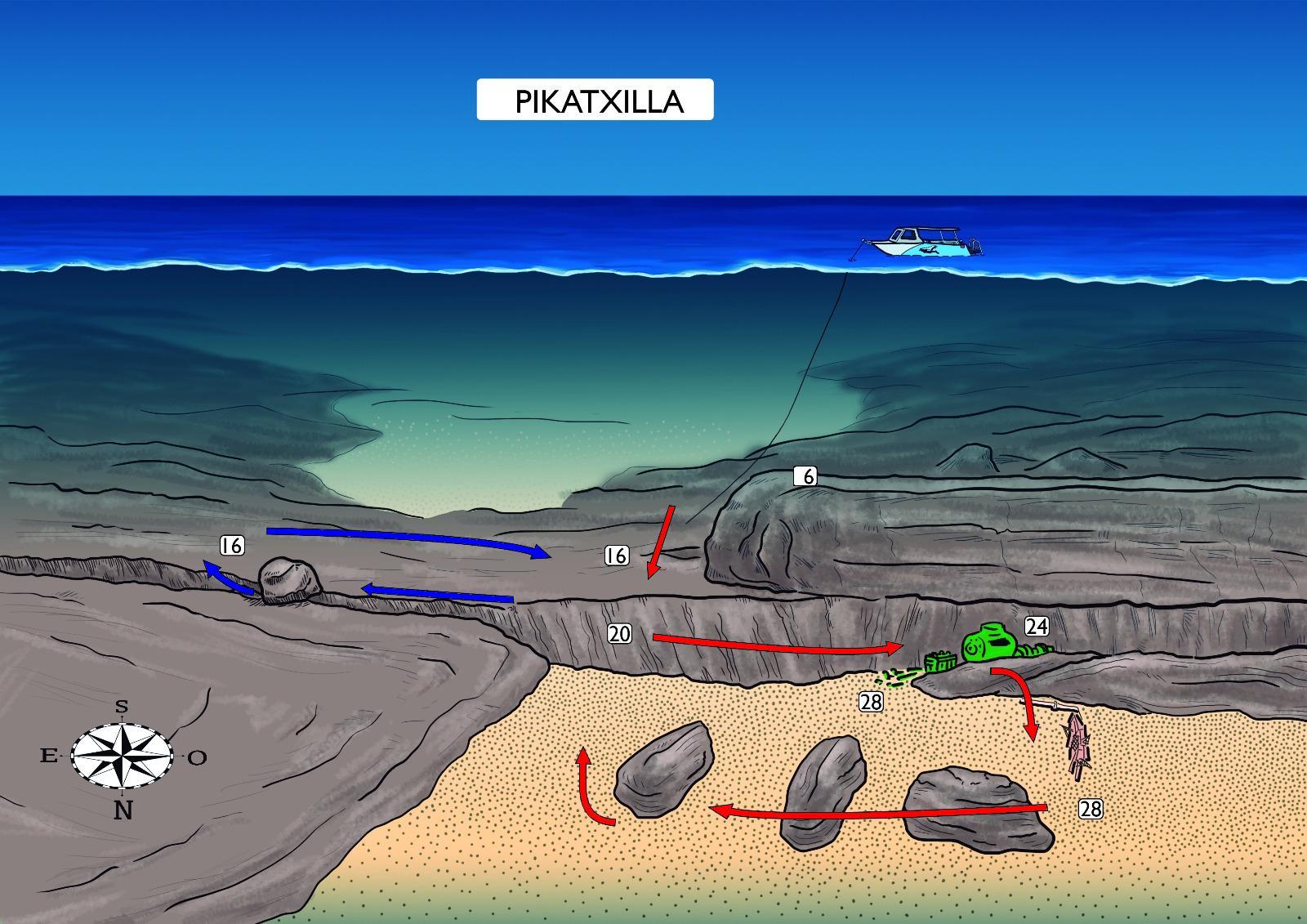
We anchor the boat on the platform where the shallows end at the east end, at a depth of 12-15m. We will always descend by the anchor line, since it is an area where currents are frequent. It is a deep dive in which we must be especially careful with our bottom time.
Given the vastness of the area and the different possibilities that exist, we will divide it into 4 possible dives.
PIKATXILLA NORTH
We will go down the cape to the anchorage area and from there we will continue descending along the north face of the wreck heading west, with the left arm against the wall. The most recommended is to navigate at mid-water, about 15-18m. deep, along the wall, up to the remains of the wreck, and to dive once we reach them, so as not to run out of bottom time.
The wreck we are going to find are the remains of a German steamship belonging to the Second World War, whose history is unknown, but we assume that for one reason or another, it crashed into the shallows of the Pikatxilla. Of this, the boiler, the engine block, and various pieces of sheet metal of the ship that are peeking or hiding under the sand depending on the year. It is an interesting area to investigate and home to a conger eel and a lobster that we will find in the boiler, as well as huge pout that prowl the area.
We will head north, and after passing over a small shallows, we will find the remains of another wreck. It is an 18th century barge, a wooden ship about 16 m. long. The barge was a merchant ship that brought cargo of iron strips from the forges for the construction of barrels. It most likely came from Orio. All that remains of it is the cargo and the frames (the “ribs of what would be the skeleton of the ship), which also usually harbors a lot of life around it.
If we have bottom time and air, we can approach the rocks of the moons, a cleaning station where they can be seen, heading northeast. Once we decide to start the return to the cape, we will head south looking for the shallow wall, and return east, with the wall against the right arm or along the ridge looking for the anchorage.
PIKATXILLA SOUTH
There is a second variant of a medium level, not as deep as the northern part.
Starting from the anchor headland, we descend along the south side of the shallows to a depth of approx. 24 m. From this point, continuing in a southeasterly direction, we find the wreck of a txitxarro fishing boat, the ROBER. This ship was similar to the “Mater”, the ship-museum located in Trintxerpe.
On January 18, 1993, the Rober was fishing for txitxarro off the coast of Ulia, near Mompas. At about 10 o’clock at night, due to the fact that the bass was not well marked on the nautical charts, it hit against the wall of the Pikatxilla, opening a leak in the hull. The ship sank in a few minutes.
The engine block, tank, nets and masts remain from the boat. It is easy to find conger eels both in the engine block and in some of the masts. There is also the possibility of seeing San Pedros, octopus, cuttlefish and even a mosaic ray.
We will continue the dive approaching the wall of the Pikatxilla and sail west. If we have good consumption and bottom time, we will be able to reach an area of passes, where there is a possibility of finding lobsters.
From the point where we decide to turn around, we will ascend to the platform and return in an easterly direction to the anchorage.
EAST PIKATXILLA
A good alternative for those who like passes and caves. From the anchorage we drop down the north face in an easterly direction. We get between two slabs and we will end up finding a passage-tunnel at about 25 m., where we can find lobsters, spider crabs, scrapers, … If we continue further east, we will find more steps and we can investigate a little under the roofs of the stone formations in the area.
Once we decide to return to the anchorage, we will ascend to the platform located at about 15 meters. And we will return westward along the same platform or through a small canyon that is formed in the area, until we find the wall of the shallows.
STONES OF THE MOONS
If we see the moonfish jumping on the surface, this variant can be a good option, as there is a chance to see them on the bottom. The moonfish stones are actually a cleaning station. Remember that at the slightest noise or flash of light they run away.
This is a deep dive, so we must be careful with our bottom time. We start from the platform where we anchor at about 15m, but the moonshots have a bottom of 28-30m. We will reach them by heading north from the anchorage, sailing mid-water in the blue. When you reach the first stone, go around it and head west, jumping from one to another until you visit all 3 stones. Once we have finished the stones, we would be in the area of the barge. From the barge we can easily reach the steam boiler by heading south and from there we will look for the wall of the Pikatxilla.
Once we decide to start our return, we will head east along the wall or along the ridge.
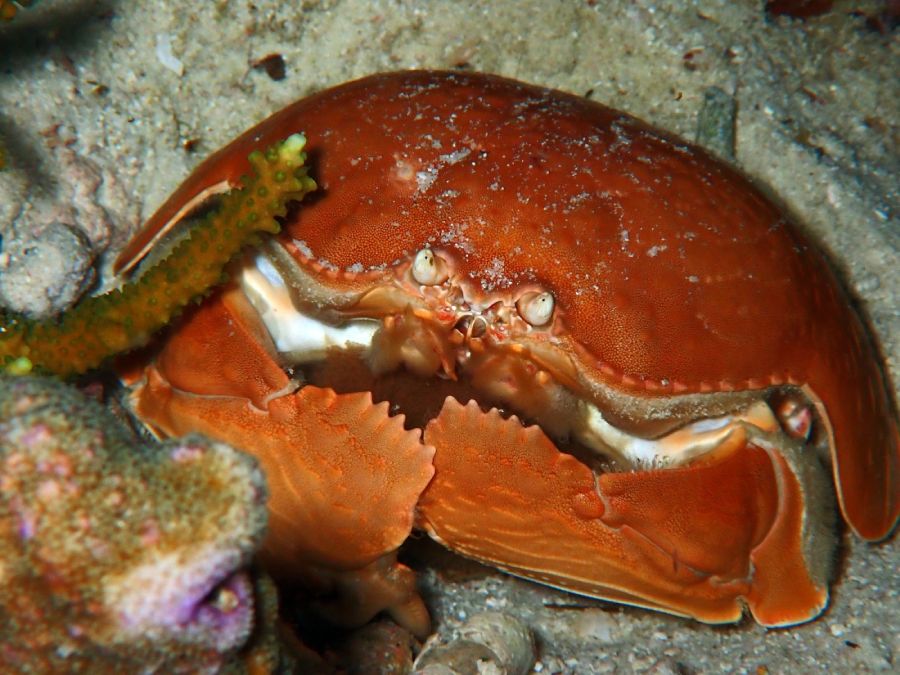
On the walls of the Pikatxilla we can find a multitude of nudibranchs, santiaguiños, galateas,…. On the crest, gobies and blennies, octopus, triggerfish, schools of txitxarros, bream and sea bass. On the remains of the wrecks, conger eels and lobsters, spider crabs, mosaic rays, monkfish, cuttlefish, pout and even spotted dogfish. Let’s not forget to look up for sunfish.