The dive site will be chosen according to sea conditions and the characteristics of the group.

Seno is the closest dive to our embarkation point. It is located at the mouth of Pasaia, at the entrance to the port, protected by Jaizkibel and Mendiola. This situation means that the area is sheltered from the prevailing NW winds, which are the ones that make the sea in our area not ideal for diving.
The bay of Pasaia has a complicated entrance for ships due to the existence of two large shallows, La Bantxa del Este and La Bantxa del Oeste, one on each side of the entrance to the port. This has caused, during the course of the centuries, numerous ships to be wrecked in this area, leaving us a multitude of remains. Anchors from the XVI to XVIII centuries of different sizes, cannons and ceramic remains rest in El Seno. Some of these anchors and cannons were dropped by the ships themselves. At this time, the ships sailed “in ballast”, to keep the unladen ships stable, and once they were loaded, they had to get rid of it.
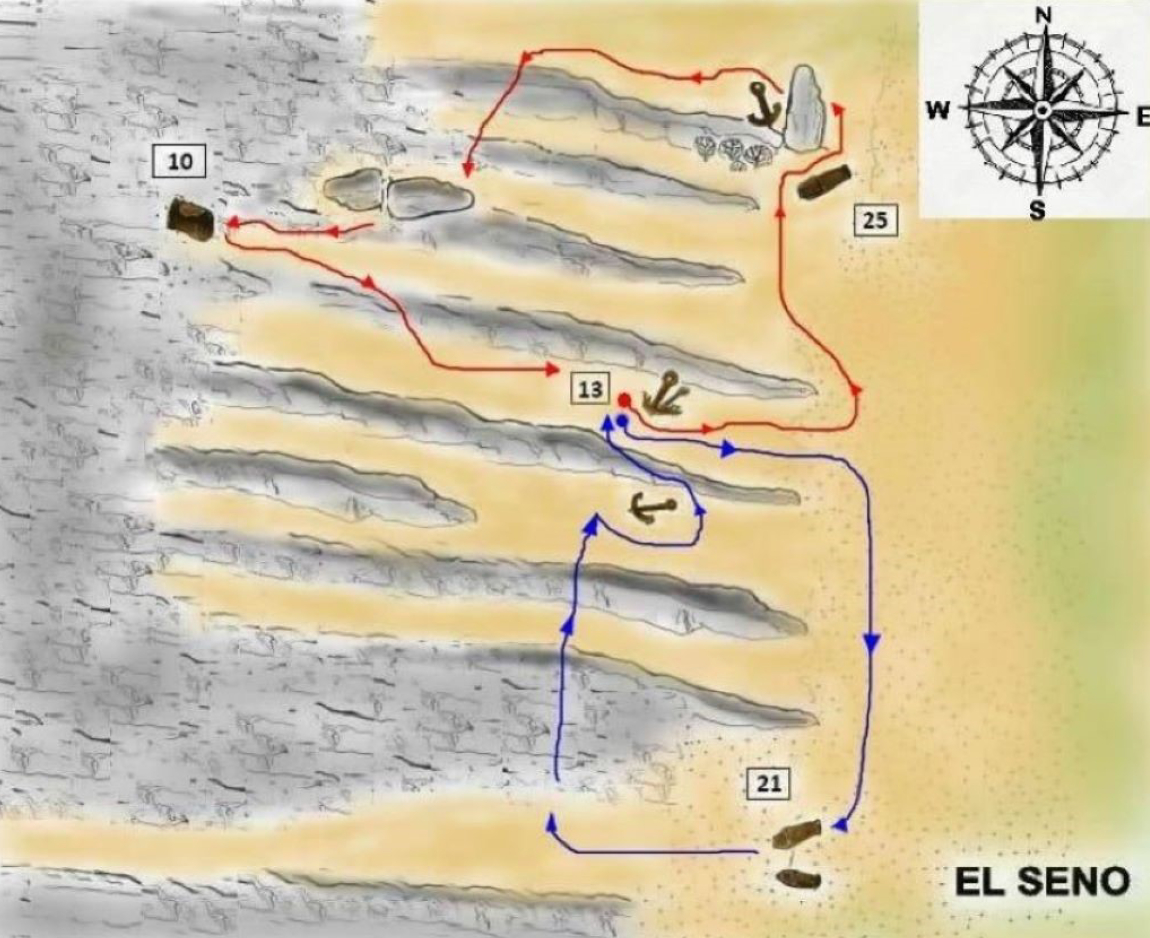
The landscape in the background is an extension of the mountain, where we will find the same slabs with west-east orientation that extend to reach the sand about 25 m deep next to the entrance channel.
Because this is a very large area, at least two dives are needed to see everything. The anchoring point will be located at about 10-12 m. The anchoring point will be located at a depth of 10-12 m., next to the anchor, one of the first remains of ships that we will find. It is an admiralty anchor, supported by a nail and the mast is about 3m long, with the arganeum (the line coming from the ship was tied directly to the anchor making firm in the ring in the anchors of that time).
In the two areas to be visited the dive starts in the same way: we will go down the cape to the anchorage. We will take an easterly direction following the slab and passing next to the inclined anchor. We will gain depth until we reach the sand. A conger eel usually hides in this slab almost at the end of the slab.
THE NORTH BREAST
To make this dive, once on the sand we head north. Continuing along the end of the cliff, where it meets the sand channel, we will find a 2.5 m iron cannon near the wall that closes the sinus. If we go around this wall to continue along its north side towards the west, we can find a large old anchor of 4.10 m. mast, the largest anchor in the whole area. We will return from this point in a southerly direction, flying over the closing wall of the sinus. If we have enough air left, we will head west towards the remains of the turret that once stood on the slab to mark the entrance to the port. It is a place frequented by torpedoes or scrapers. However, it is easier to visit this point from another of the dives in the area: that of the Tajo gunboat.
On the way back to the anchorage, heading south, a couple of slabs before and about 10 m. deep, we will find an interesting area to visit, formed by large stones that suggest a roof where we have come to find lobsters. Near this area, we can also find a hollow deposit.
If we go down to the anchorage and continue south, we will soon find our anchor.
THE SOUTHERN BREAST
Starting from the sand, we will head south, along the edge of the sand channel and the cliff. With a bit of luck it is not difficult to find sole and cuttlefish. Along the way we will come across two canyons, one very close to the other, about 20-22 m deep. From this point, we can start our return by climbing up to about 15 m. ascending a sandy tongue. Once we reach the chosen level for our return, we will head north towards the anchorage, crossing the slabs. One slab before reaching the anchorage, we will find the anchor lying, a little smaller than the first (about 1.5-2m.), And very mimicked.
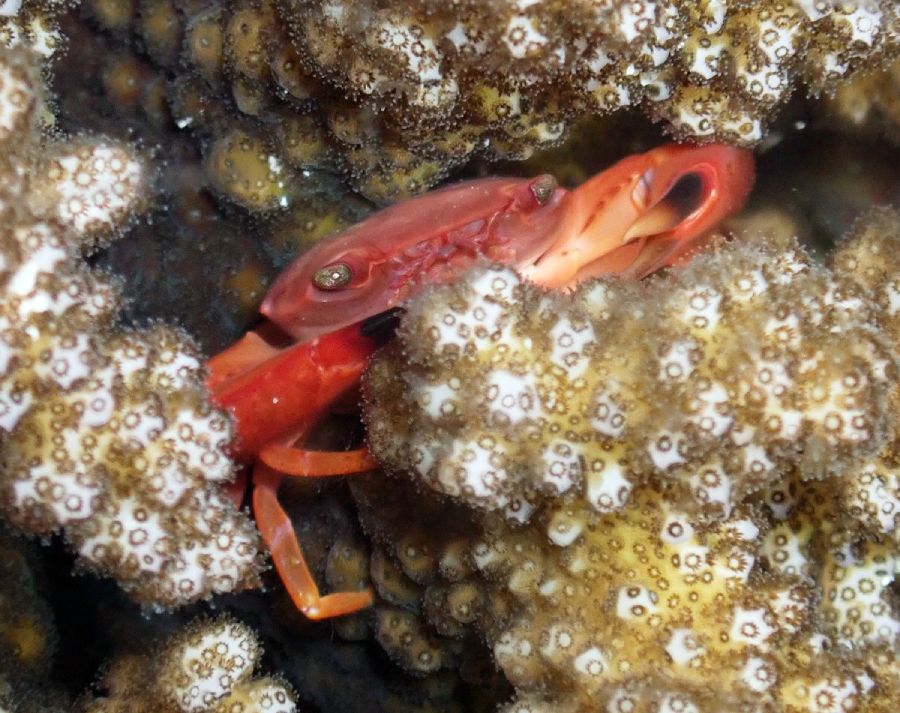
In the holes or among the rocks we can find conger eels, lobsters, spider crabs, octopus, nudibranchs and planaria, beautiful gorgonians, scrapers and even the San Pedro fish. It is very easy to see crabs and galateas, and we have even found santiaguiños and cuttlefish,…