The dive site will be chosen according to sea conditions and the characteristics of the group.

Kalaburtza is one of those dives that we have always used especially for course, but we have discovered that it is more than interesting and that it offers a lot of life of all kinds.
It is a very protected area from the Cantabrian Sea, and is used by the people of the village as a small beach.
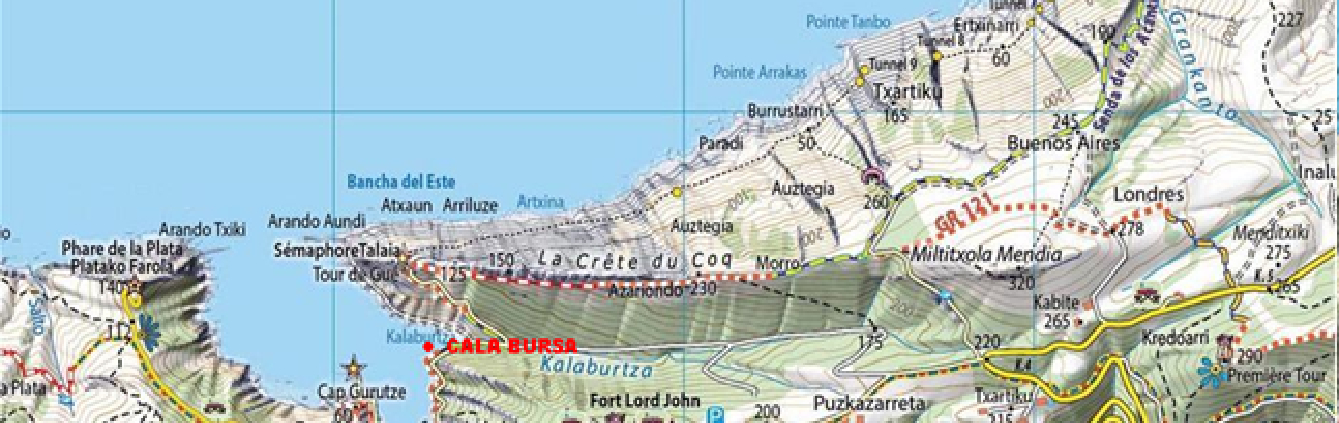
On the night of September 12-13, 1936, in the middle of the Civil War, the cargo ship “Jata mendi” was sunk in the mouth of Pasaia, at the height of kalaburtza, to hinder the entry of the national troops in the waters of the port.
The sinking of an important ship in a narrow entrance channel constituted the total uselessness of the port for a long period of time, and the deprivation of a fundamental base and supply point for the National Army. For this purpose, the Jata Mendi was brought from Bilbao, a ship that was to be scrapped, and at the appointed time it was beached in the shallows where the canteen is located.
Parts of this ship, ornamented with marine life, can still be found in the area.
We start the dive at about 5m. depth, on a mixed sand and rock bottom. The whole dive presents more or less the same pattern: sand channel and rocky wall. From our anchorage, we will head west, and our depth will gradually increase until we reach the channel. Along the way, the first thing we will find is a field of anemones. Continuing our course to the west, we will find a sandy area with loose rocks that goes down to the channel.
More or less in the area where we must change direction, we will find the first remains of the Jata Mendi: a long piece of pipe. We are in the channel, and at this point we will be around 10 m. depth. We will take a southerly course, sailing close to the rock wall, leaving it on our left arm. Soon we will find the remains of the ship, small pieces of iron very mimetized with the rocks. As we continue on our course, more wreckage will continue to appear, floating lines with lots of life, especially nudibranchs, which often attach themselves to the line and lay their eggs.
A little further south, following the channel, and keeping close to the rocks of the wall, there is an area with a large colony of Spirographs, located inside some tires.
We must be careful not to go too far into the channel, as it is a passage area for large ships. This point is around 16m. depth.
Once we reach the halfway point of our tank or dive time, we will begin our return to the cape. We will head east until we find the rocky wall, and return north until we find the cut in the wall that gives us access to the beach. Throughout this rocky area, we will be able to enjoy holes where we can find conger eels and crustaceans. From there, locating the piece of pipe, and taking an easterly course, we will reach our ship.
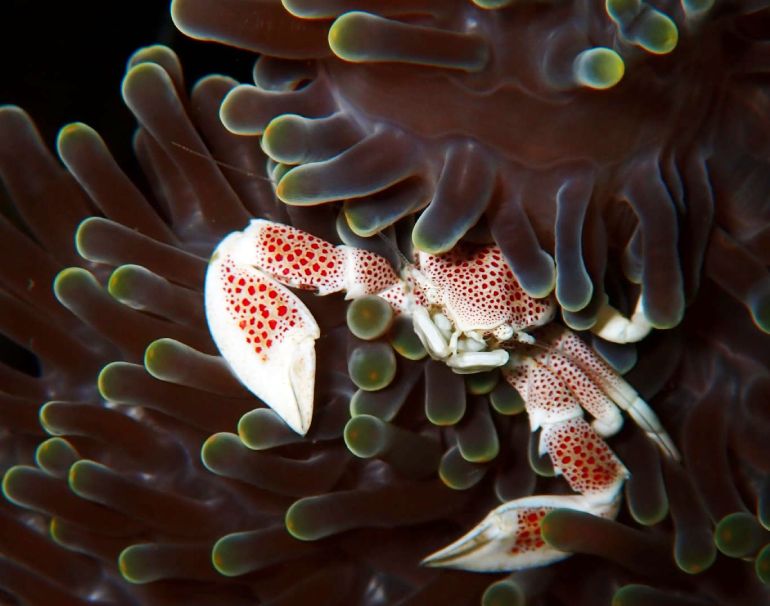
In the sand we can easily locate quite large soles. Conger eels and spider crabs in the rocky area of the channel; small crabs and octopus on any rock. There is also a large presence of flabellinas and Dondices. Cuttlefish, large colonies of white spirographs, spider crabs among the anemones,…