
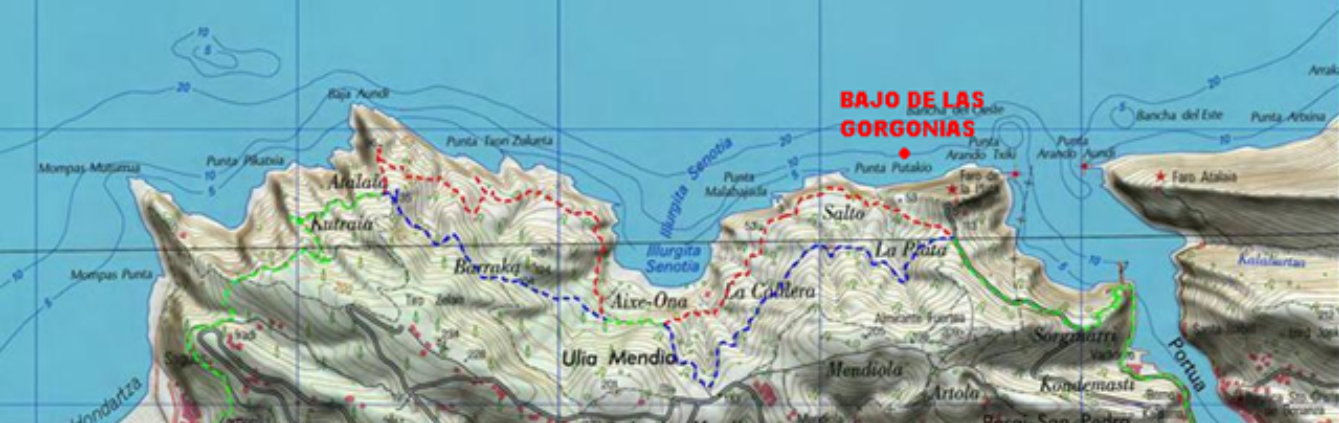
This point is located in the shallows of Mount Ulia, a few meters from the mouth of Pasaia. It is so called because of the quantity and size of the gorgonians it shelters.
Gorgonians are a type of soft coral, and one of the few corals found in our waters.
Gorgonians only grow 1 to 2 cm per year, so we must be especially careful with our fins and our buoyancy when diving near them.
In 2014 this bass provided us with a show of hundreds of unforgettable moons.
The first floor has an EAST-WEST orientation, which will decrease in height on the east side until it disappears abruptly.
The NORTH face presents a fairly deep slope, with a first step that drops to 20m, and a second step that would go down to the bottom at about 30m.
The most interesting part of this dive is on the SOUTH FACE. The south bottom, full of rocks, will provide us with holes where all kinds of crustaceans and conger eels hide, ornamented in turn with large gorgonians.
Anchoring is attempted on the north side, due to the presence of gorgonians on the south side, at a depth of 10-12 m.
A typical dive would be to descend the cape on the south side of the shallows, and sail east. We can sail along the bottom (23-26 m) or along the wall. These walls and rocky bottoms are home to lobsters, conger eels, spider crabs and lobsters. We can also find a multitude of nudibranchs, octopus and other life.
We can continue along the corridor that provides us with the low with the next slab, or explore the rocks further south, also a very interesting area.
At one point, the wall cuts off abruptly, and it is the ideal place to start our return. We can return along the north face looking for nudibranchs, octopus and sea hares, and keeping an eye on the blue for sunfish.
Sailing to the west we will see that the bass rises quite a lot at one point (up to 6-10 m). Flying over the ridge it is also possible to see a multitude of schools of jacks and breams, and even jellyfish.
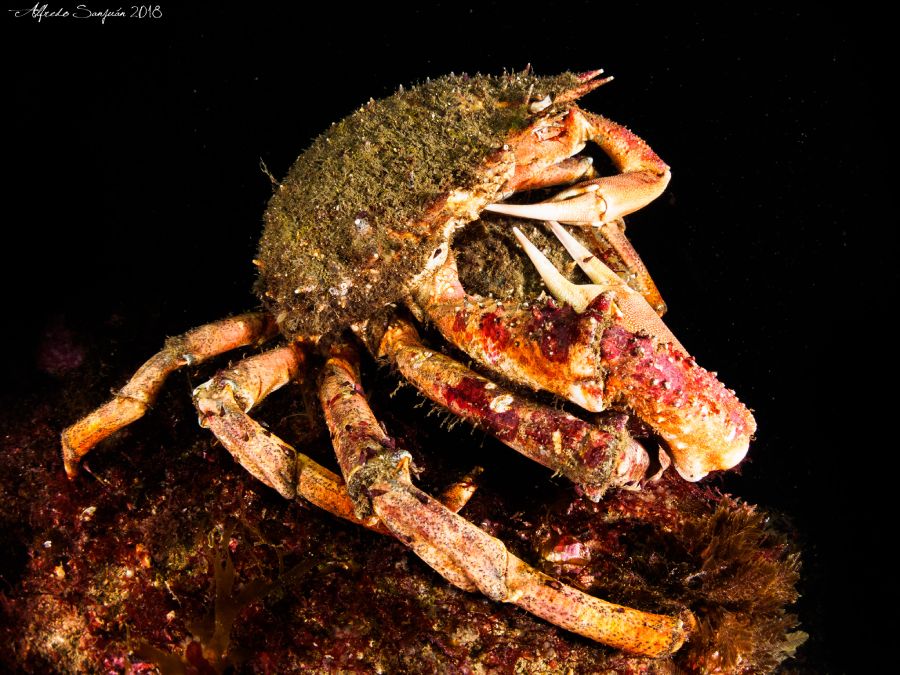
It is a favorable area to find a lot of crustaceans. We can see lobsters and lobster in the crevices of the south wall, spider crabs perched on the rocks at the bottom or along the wall, and conger eels in the cuts and crevices of the wall. It also offers a great variety of nudibranchs, especially on the north wall, but we will also see them on the south side of the shallows. Sea hares, planarians, and of course beautiful gorgonians. On the ridge, a multitude of schools of fish and let’s not forget the moons. There are usually jellyfish also when it is the season.