
The Illurguieta Cove, also known as Cala Murgita or rocks of Mendiola, is a cove located on the slopes of Mount Ulia, in the area of Mendiola, leaving the mouth of Pasaia heading west from the silver lighthouse. It is a rocky cove with boulders, known for the existence of paramoudras and for having permission for nudists. Therefore, everyone facing north!
Legend has it that the pirates of Pasaia used to light their torches at dusk in Illurgieta Cove. With the goods stolen from the ships, the pirates filled their bellies with products from all over the world (chocolate, cocoa, coffee), and got drunk with rum while they distributed their booty. Look well at the bottom, because it is said that there is still a chest hidden in the sand. Maybe you can find some gold coins at the bottom.
In terms of diving, this is a cove where we usually go to dive when courses and baptisms are held, because it is very protected from the swell and swell entry, as the slabs close it forming a kind of pool. On the other hand, it is one of the few dives where you can find mosaic rays, and it is very worthwhile.
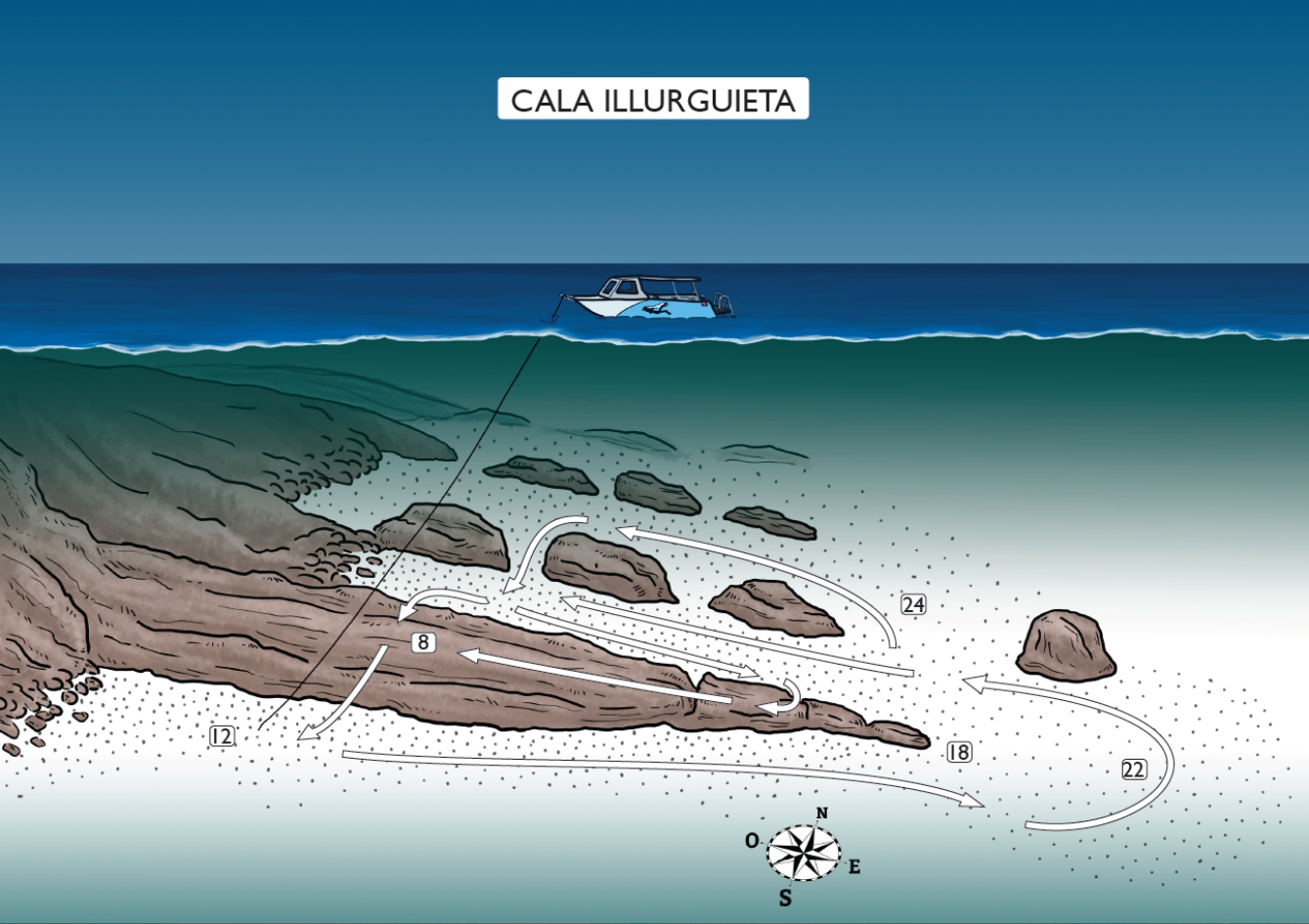
The anchorage is located about 10 m. deep, in an area of rock and sand, in the southern part of our main slab.
To observe the most interesting areas of this dive site, we will navigate in a rectangle.
We will locate the main slab heading North from the anchorage and we will go down the sand channel that is created between the South face of this slab and the adjacent rocks, with the left arm against the wall, heading East. Throughout this area we can find conger eels and octopus in the holes of the slab, torpedoes and soles in the sand,… We will gradually get deeper until the wall disappears into the sand, reaching a kind of beach. We will be about 18-20 m. deep in this area.
If we continue eastward along the sand at the end of the slab, we will see some loose rocks on which we can see mosaic stripes.
From this point, we will continue heading north where we will find a series of very interesting slabs cut to visit, about 22-24 m. deep. It is an area of mosaic rays, soles and cuttlefish in the sand, and nudibranchs and planarians, captain stars,… in the rocks.
To return to the anchorage, we will return south until we find the main slab again and sail west along the north side of the slab or along its crest to the area where the beach ends and the boulders and rocks begin. From this point if we take a southerly course, we will find our anchorage.
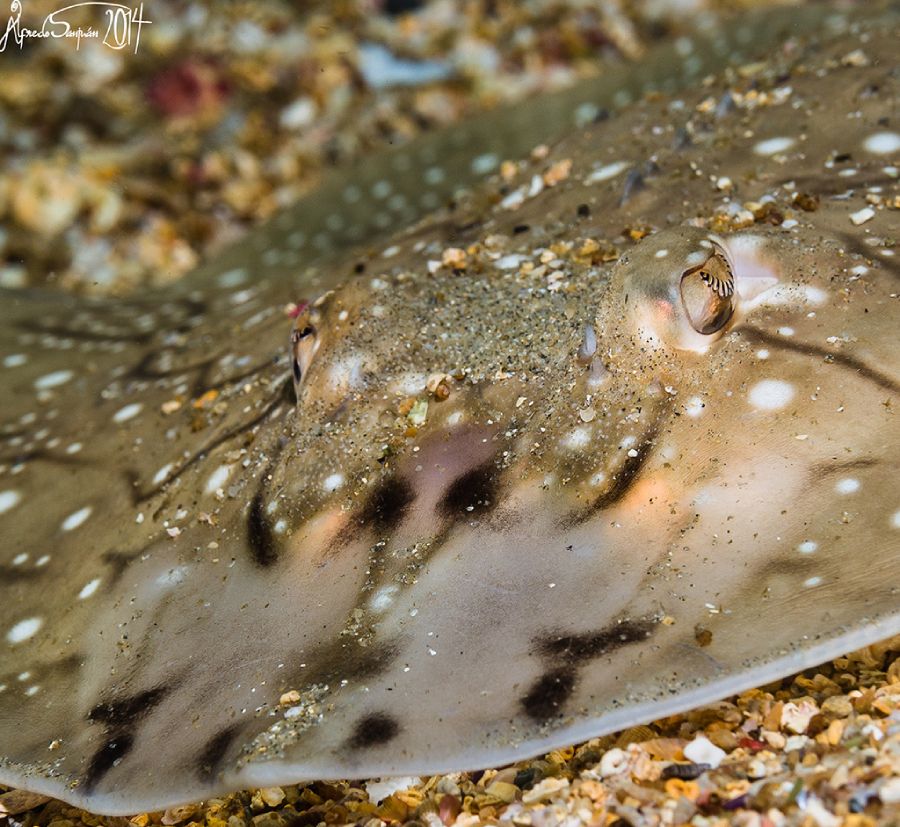
Obviously the star in this case is the mosaic ray. But we can also see octopuses, conger eels, sole, cuttlefish, nudibranchs, planarians, mullets among the red algae, skipper stars, scrapers,…